What is competitive benchmarking, and why most teams skip it
Competitive benchmarking compares you with the companies your customers compare you with. What makes a benchmark useful, and why most die in a spreadsheet.
First published on our newsletter on Substack on .
Competitive benchmarking is comparing yourself with the companies your customers actually compare you with, on the things those customers care about: price, features, positioning, how you sell and what customers say.
Why do teams skip competitive benchmarking?
Large companies have analysts for this. Everyone else usually does it once, in a spreadsheet, while writing a pitch deck, and then never touches it again. A year later the spreadsheet can still say a competitor costs $49 when they’ve moved to $79, and someone on the team is quoting the old number on calls.
Why does competitive benchmarking matter?
That’s the first reason benchmarking matters: your market moves whether you look or not. The second is that a benchmark tells you where you stand, not where you’d like to stand. It’s easy to believe you’re the cheaper option or the simpler one. A side-by-side table is less kind and more useful.
What makes a competitive benchmark useful?
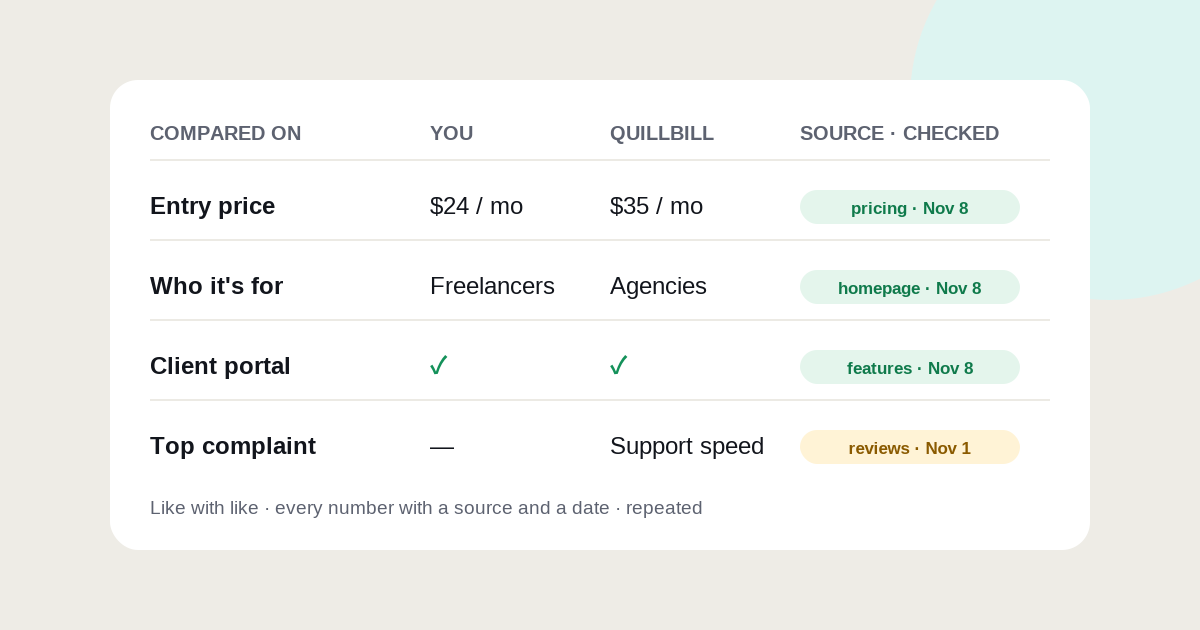
A useful benchmark has three properties. It compares like with like: the same plan tier, the same customer size, the same feature. Every number in it has a source and a date. And it’s repeated: one check shows a position, two checks show a direction.
The third property is where most benchmarks die. Nobody owns the update, the table goes stale, and people quietly stop trusting it.
This newsletter is about benchmarking well with nothing but public information and a browser: pricing pages, changelogs, job posts, ads and reviews. What to compare, how often, and how to turn a comparison into a decision. Short posts, a couple a week.
If it’s useful, forward it to the person on your team who keeps the competitor spreadsheet.
Frequently asked questions
What is competitive benchmarking?
Comparing yourself with the companies your customers actually compare you with, on what those customers care about: price, features, positioning, how you sell and what customers say.
What makes a competitive benchmark useful?
It compares like with like (the same plan tier, customer size and feature), every number has a source and a date, and it's repeated.
Why do most competitive benchmarks go stale?
Nobody owns the update. The table goes stale, and people quietly stop trusting it.
New notes like this go out on LinkedIn first. Follow Rivalscope on LinkedIn.