What competitors stop doing: the signal most teams miss
Competitor retreats rarely get announced: a free plan disappears, a feature page leaves the menu, an integration is delisted. Why they matter and how to spot them.
First published on LinkedIn on .
The most useful competitor signal is often what a competitor stops doing, not what it launches. Launches get announced; retreats rarely do, so few teams notice them.
What does a competitor retreat look like?
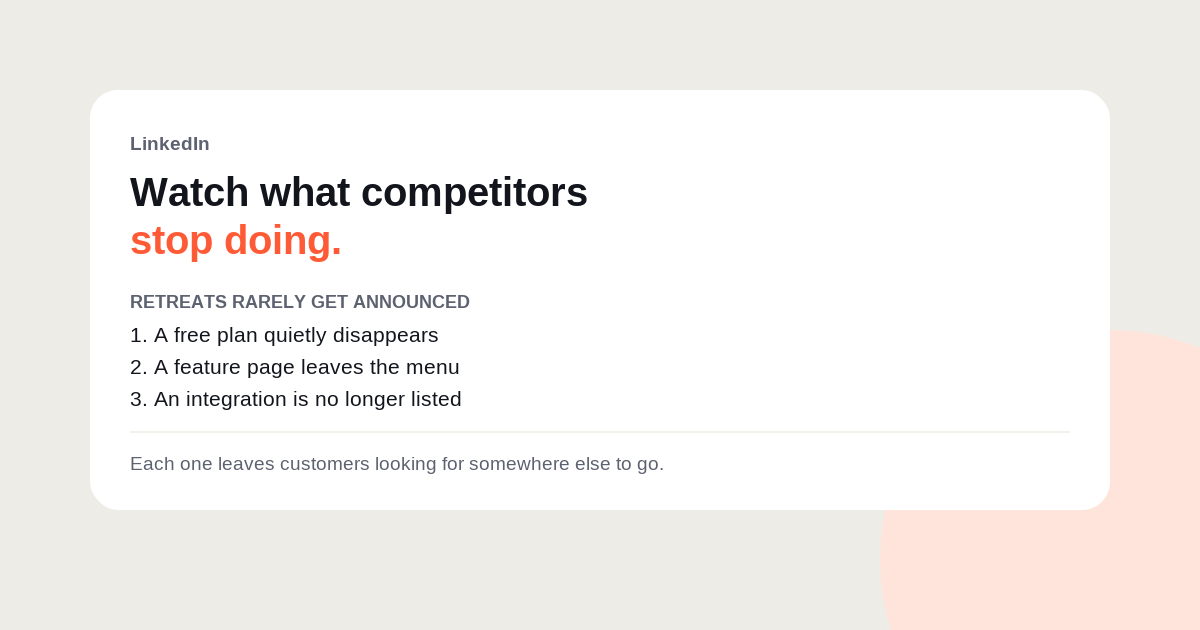
- A free plan quietly disappears. Its users now have to pay or move.
- A feature page is removed from the menu. The feature may still exist, but it is no longer what they want to sell.
- An integration is no longer listed. Customers who depend on it start looking around.
- Job posts in one country stop appearing. The expansion there may be on hold.
Why do retreats matter more than launches?
Every one of these leaves customers looking for somewhere else to go. A launch tells you where a competitor wants to compete. A retreat tells you where its customers are now open to an alternative, and nobody else is looking.
How do you spot what a competitor stopped doing?
Absences are hard to see on a single visit, because a page only shows what is there today. Keep a dated note of a competitor's plans, menu items, integrations list and open roles, and compare it with the same pages a month later. The lines that disappeared are the ones worth a conversation.
Frequently asked questions
What is a competitor retreat?
A competitor retreat is something a competitor stops offering or promoting: a free plan, a feature page in the menu, a listed integration or hiring in a country. It is rarely announced.
Why should SaaS teams watch what competitors stop doing?
Because each retreat leaves customers looking for an alternative, and few teams notice it, so the team that does can reach those customers first.
New notes like this go out on LinkedIn first. Follow Rivalscope on LinkedIn.