From competitive benchmark to decision: one row, one owner
Why most competitive benchmarks fail after the meeting, three things to write next to every finding, and a comparison table that still quotes an old price.
First published on our newsletter on Substack on .
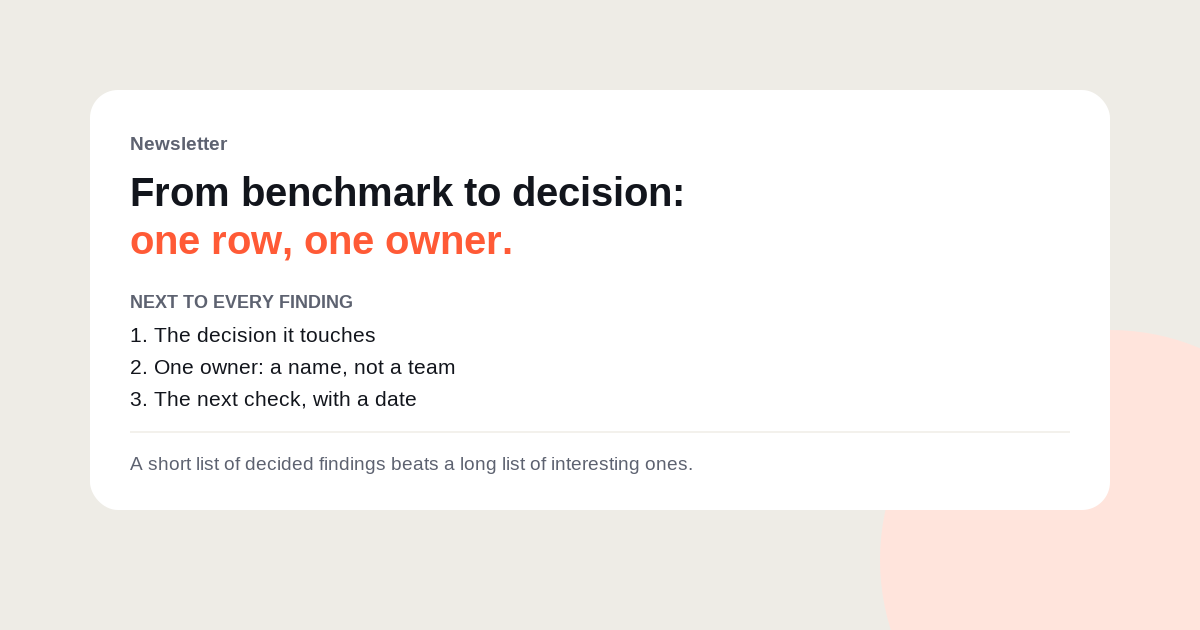
A competitive benchmark turns into decisions when every finding has three things next to it: the decision it touches, one owner and the date of the next check. The most common way a benchmark fails isn't bad data. It's that nothing happens after the meeting.
What should you write next to every finding?
For every finding worth discussing, write three more things next to it:
- The decision it touches: pricing, messaging, roadmap or sales.
- One owner: a name, not a team.
- The next check: the date you'll look again, and what would change your mind.
Most findings end with "no action, check again next month". That's a fine outcome, as long as it's written down. What you want to avoid is the same finding showing up three months in a row with nobody deciding anything.
A short list of decided findings beats a long list of interesting ones.
From our tracking
On 1 November WooCommerce published a new pricing page with a cost table comparing itself to Shopify, BigCommerce, Wix, Salesforce and Adobe. On 13 November it started Google Search and LinkedIn ads.
The table lists BigCommerce Core as "$29/mo, online revenue capped at $50k". BigCommerce's own pricing page shows Core at $39 a month, for stores up to $30K in trailing 12-month sales (WooCommerce's table checked 21 Nov; BigCommerce's page checked again 24 Nov).
Comparison tables get written once and competitors keep moving, but buyers read them as fact. A 2-minute check for your own market: search "[your product] vs", open the top three pages that compare you, and check your price, plan names and limits on each.
We watch e-commerce platforms this month; the same signals show up in CRM, HR software, project tools: any category.
Frequently asked questions
Why do competitive benchmarks fail?
Usually not because of bad data, but because nothing happens after the meeting: the findings have no decision, no owner and no next check.
Is 'no action' a valid outcome for a benchmark finding?
Yes, as long as it's written down with the date of the next check. What to avoid is the same finding showing up three months in a row with nobody deciding anything.
How do you check the comparison pages that mention you?
Search for your product name followed by 'vs', open the top three pages that compare you, and check your price, plan names and limits on each.
New notes like this go out on LinkedIn first. Follow Rivalscope on LinkedIn.